


Branches of Science
- Yash Jain
- Dec 24, 2021
- 1 min read

Updated: Feb 11, 2022
Science lives inside us. It is us. It enables us to discover ourselves, understand our origin, and it tries to explain why things are the way they are. In other words, it tells us about our surroundings – Environment, you can say. Recall that in younger classes, we used to study the subject EVS – Environmental Studies, which later got renamed into Science. The name was pretty self-explanatory; studying about our environment. This environment includes our surroundings, nature, people etc. We study science to try to understand the environment around us and use that understanding to find out ways to utilize the resources available to us for our benefits.

But, as many of us already know, Science is a vast field. It has many aspects – numerical, physical, intuitive, logical, social etc. Based on these aspects, Science has been divided into various BRANCHES OF SCIENCE. The following table would help us in understanding their sub-branches.

NOTE : PLEASE CLICK ON THE HEADINGS TO EXPAND TO THE CONTENT OF THAT HEADING
FORMAL SCIENCES: These scientific disciplines are the ones that use formal systems to generate knowledge. These are the building blocks of our scientific disciplines.
All the other disciplines have been derived from the formal sciences. The most basic form of formal science disciplines are:
1. LOGIC – Logic can be understood as the correct decision making study, which is driven by a species’ different norms like social, educational norms etc.
2. MATHEMATICS – Mathematics is the branch of study that deals with the logic of shape, quantity and arrangement. It is the building block of all the other sciences that exist till now. Some even say that, it is the ‘Language of God’, as they believe that mathematics is the way of the supreme to communicate with us.

3. COMPUTER SCIENCE THEORY – The Computer Science Theory is the branch of study that deals with the underlying principles that enable a computer system, and sub-systems to work. This includes high-level and low-level programming languages, database systems, boolean algebra etc.

4. SYSTEMS THEORY – Systems Theory is the branch of formal science that defines a set of fundamental principles that can be used in all scientific disciplines, regardless of their scope.

5. DECISIONS THEORY – Decision Theory is the branch of formal science that studies the decisions that any agent (living, non-living) takes, willingly or unwillingly, and try to explain how or why the agents took those decisions. There is still no exact clarity on what decision theory actually means, but many researchers have presumed it to be associated with Game Theory.

NATURAL SCIENCES: These scientific disciplines are the ones that are used to study the natural phenomena that occur around us. These disciplines try to decode the science behind these phenomena, and try to analyze how or what causes them.
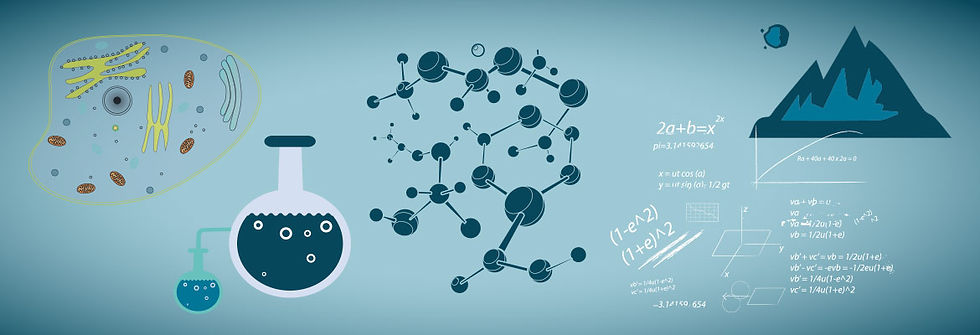
Natural Sciences are further divided into 2 categories – PHYSICAL SCIENCES and LIFE SCIENCES.
PHYSICAL SCIENCES is the branch of Natural Science that deals with the study of Non-Living systems.

These disciplines include -
1. PHYSICS – Physics is the branch of physical sciences that deals with the study of matter’s motion through space-time, and its intrinsic properties like energy, force etc. Basically, it is the analysis of natural processes to understand the universe better.

2. CHEMISTRY – Chemistry is the branch of Physical Sciences, which studies the building blocks of matter, along with their changes (physical changes, thermodynamic changes etc). While physics deal with the external factors of a system that may or may not change its properties, chemistry deals with the internal factors and / or how they may or may not change the system’s properties.

3. PLANETARY SCIENCE – Planetary Science is the discipline of Physical Sciences that deals with the study of the physics and chemistry of planetary bodies, like planets, moons etc. The most specific planetary science we use is Earth Science (GeoScience), which studies the properties of Earth and everything inside Earth.

4. SPACE SCIENCES – Space Science is the discipline of Physical Science which studies outer space, and everything inside it. Space Sciences is not only limited to planets, but to solar systems, suns, galaxies, and other cosmic bodies. It is one of the most sophisticated, and vast disciplines that include Astronautics, Astronomy, Cosmology and various other domains.

LIFE SCIENCES (BIOLOGY) is the branch of Natural Science that deals with the study of Living systems, and their interactions with living and non-living systems.

These disciplines include -
1. BOTANY – Botany, or Plant Science, is the branch of biology that deals with plant life, and its study. Traditionally, the scope of Botany was limited to algae and fungi. Now, it studies all the phenomena that involve plants, and how they affect them. It consists of both water plants and terrestrial plants, and in the future, if any plants are found on other planets, those as well.

2. BIOCHEMISTRY – As the name suggests, Biochemistry is the discipline of biology that is concerned with the chemistry of living organisms. It includes various sub-groups like genetics, physiology, and cell biology.

3. MICROBIOLOGY – Microbiology is the study of tiny living organisms. These organisms include single-celled (unicellular), multi-celled (multicellular) or even those organisms who don’t have cells (acellular). It has various sub-disciplines like immunology, bacteriology etc.

4. ZOOLOGY– Zoology is the branch of biology that is concerned with the study and evolution of the animal kingdom (fauna). It consists of species (both present and extinct), and how they interact with their environments. Various sub-disciplines of zoology are - anthrozoology, arachnology, archaeozoology, cetology etc.

5. ECOLOGY – Ecology is the branch of biology that studies the biodiversity of various ecosystems within our universal ecosystem. It concerns itself with the biotic and abiotic environments, and how various species cooperated and competed amongst each other.

SOCIAL SCIENCES: These scientific disciplines are the disciplines that deal with the study of societies and their relationships. As humans, it is our natural instinct to socialize, and we come across many of these disciplines in our daily lives.

Social Scientists use natural science techniques to study human behavior in groups / societies. These disciplines include -
1. SOCIOLOGY – Sociology is the branch of Social Science that deals with the functioning of the society as a group. It focuses on human interactions individually, and in social groups, along with human relationships and patterns in their behavior. In fact, for a long time, Social Science was considered as only Sociology.

2. ANTHROPOLOGY –. Anthropology is the branch of Social Science that deals with the human behavior, biology, cultures and linguistics from the ancestors to the present time. The main goal of Anthropology is to understand, or find out the evolutionary origins of our species.

3. ARCHAEOLOGY – Archaeology is the branch of Social Science that studies humans from the ancient period to the present time via non-living items – fossils, ancient structures etc. This branch collects data from these non-living items to study the human evolution and growth.

4. ECONOMICS – Economics is the branch of social science, which explains humans’ economic behavior – i.e. – when scarce resources are exchanged. It tries to explain how humans change their interactions with one another, when it comes to dealing with other humans for consumer purposes. It studies how people individually, or collectively (society, government etc) make decisions to distribute resources.

5. POLITICAL SCIENCE – Political Science is a social science which deals with the human interactions, when they are given power to make decisions for others (also known as politics). It studies the influence of power, law and other political activities on our society as a whole, as well as on individuals.

6. PSYCHOLOGY – Psychology is the branch of Social Science which deals with the study of the human brain. Most of our emotions, decisions, and body react the way our minds tell them to. Psychology is the study of human brain, which determines / drives their behavior, and is actively involved in understanding brain functions, and mental processes of humans.

7. GEOGRAPHY – Geography is the branch of Social Science, which studies territories, people and their relationships with places. Geography seeks to understand where things are found, why they are there, and what are could happen to them in the future, as well as how they influence the societies (people) around them.
8. LINGUISTICS – Linguistics is the branch of Social Science which deals with the gift of voice and human language. This branch focuses itself on various languages, their origins and cultural developments, the hidden meanings behind the development of these languages, and their current and future holdings. It studies the analytical aspects of every language, and the methods to learn them.

9. MANAGEMENT AND BUSINESS – Management is a branch of Social Science which concerns itself with the way people handle each other in a professional / working and serious environment. It is the way people work with each other, and build corporate relationships that benefit both the parties. Business is the reason management is important. It is another social science, wherein one or more humans provide goods or services to others to make their lives easier, in exchange for money.

APPLIED SCIENCES: These are the disciplines that deal with the application of scientific principles in order to create inventions that help people in making their lives easier.

These disciplines use scientific theories, and develop products that use those theories for the benefit of humanity, or other communities. These disciplines include -
1. ENGINEERING – Engineering is the branch of Applied Sciences which deals with building things using scientific principles for the progress and growth of humanity. It is one of the most desired branches of study all around the world. There are more than 60 branches of engineering sciences in India alone. Some of the most common engineering disciplines are Mechanical Engg, Civil Engg, and Computer Science Engg etc.

2. MEDICINE – Medicine is the branch of Applied Sciences that concerns itself with the betterment of the health of species. It is another desired field of study all around the world. Medicine includes the study of each and every aspect of human biology to better understand the systems of the human body. These sciences apply biological principles for the purpose of prolonging the human body by scientific procedures. Medicine includes Anatomy, Biomechanics, and Neuroscience etc.

These branches all contribute amazingly to the world, the solar system, and the universe we live in. All of them are equally important, and they need to be taken passionately and seriously. Those who are the true science enthusiasts, they know the beauty of these branches. All of them may not make sense, but they exist, and that is the proof that there is so much more to be explored. Not even Sky is the Limit !

Comments